
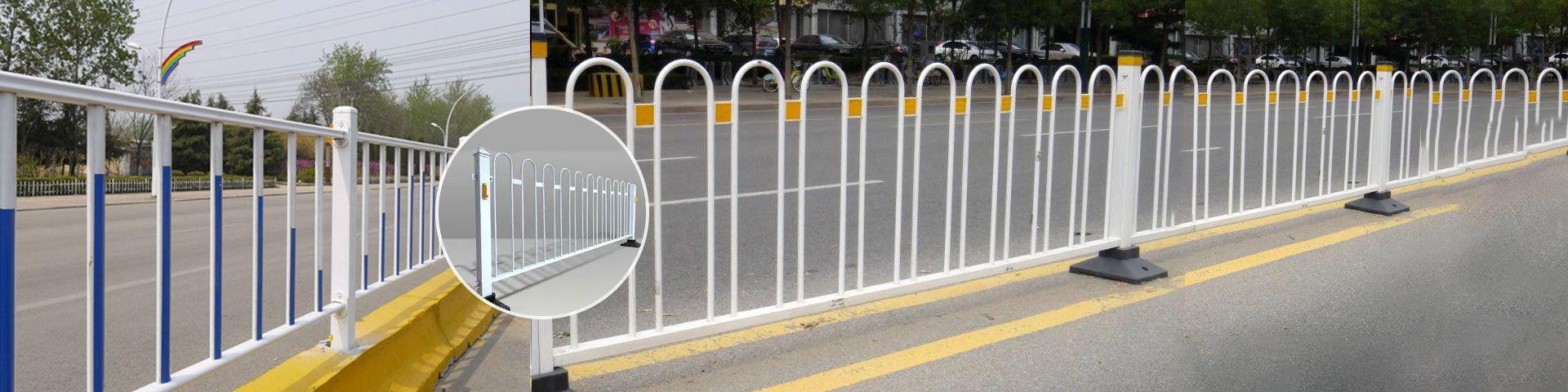
guardrail
Key words:

Shengxinpeng Beijing-style guardrails are simple and elegant, with smooth lines that meet modern urban aesthetic standards, enhancing the overall beauty of the road.
Key words:
The materials of conventional guardrails mainly include steel, aluminum alloy, stainless steel, etc.
Key words:
The anti-glare board guardrail is a protective facility installed on both sides or in the center of the road. Its main function is to prevent vehicles from deviating from their driving direction due to glare, collisions, and other reasons, ensuring driving safety.
Key words:
Stainless steel railings showcase strong practicality due to their unique material advantages.
Key words:
What are the structural forms of municipal guardrail bases?
The municipal guardrail base, as an important part of supporting the guardrail, has its structural form selection directly related to the stability and service life of the guardrail. This article will explore several common structural forms of municipal guardrail bases, aiming to provide references for professionals in related fields. Cast-in-place concrete bases are the most widely used structural form among municipal guardrail bases. This type of base is usually poured on-site, allowing for flexible adjustments based on actual terrain and needs. Cast-in-place concrete bases have advantages such as strong load-bearing capacity, good stability, and high durability, making them suitable for various complex environments and climatic conditions. However, they have a longer construction period and higher environmental requirements for the construction site. Precast concrete bases, on the other hand, are bases that are pre-manufactured in factories and then transported to the site for installation. Compared to cast-in-place concrete bases, precast concrete bases have advantages such as faster construction speed, easier quality control, and less environmental impact. Additionally, precast bases can achieve standardized production, reducing production costs. However, it is important to note that special care must be taken to avoid damage during transportation and installation. Steel structure bases, with their high strength, lightweight, and ease of processing, have also been widely used in some special occasions. Steel structure bases are usually welded.
Key words:
What is the maintenance and replacement cycle for the railing base?
The base of the municipal guardrail is an important component of urban traffic infrastructure, and its maintenance and replacement are crucial for ensuring traffic safety and extending its service life. This article will explore the maintenance and replacement cycle of guardrail bases, as well as how to develop an effective maintenance plan. 1. Importance of Guardrail Base Maintenance The guardrail base, during long-term use, is affected by various factors such as the natural environment and vehicle impacts, which may lead to issues like wear, corrosion, and loosening. These problems not only affect the stability and safety of the guardrail but may also shorten its service life. Therefore, regular maintenance is key to ensuring the performance of the guardrail base. 2. Determining the Maintenance Cycle The maintenance cycle of the guardrail base usually depends on several factors: Material Type: Different materials have varying durability and corrosion resistance, thus the maintenance cycle will differ. For example, cast iron bases may require more frequent inspections and maintenance, while stainless steel or composite material bases may have a longer maintenance cycle. Usage Environment: The environment in which the guardrail base is located significantly impacts its maintenance cycle. In harsh environments with high humidity, salt spray, or industrial pollution, the base may corrode and wear out more quickly, necessitating more frequent maintenance.
Key words:
The importance of municipal guardrail bases
In the busy streets and tranquil parks of the city, municipal guardrails serve as a beautiful landscape, not only beautifying the urban environment but also playing an indispensable role in ensuring pedestrian safety and maintaining traffic order. Behind these guardrails, there is an inconspicuous yet crucial component—the municipal guardrail base. This article will delve into the importance of the municipal guardrail base, its design characteristics, and its performance in practical applications. 1. The Importance of the Municipal Guardrail Base The municipal guardrail base is the foundational support structure of the guardrail system, and its stability directly relates to the safety and stability of the entire guardrail. A high-quality base can ensure that the guardrail remains upright in various harsh weather conditions, effectively preventing safety accidents caused by the guardrail tipping over. In addition, the design of the base also affects the overall aesthetic of the guardrail and its harmony with the surrounding environment. 2. Design Characteristics of the Municipal Guardrail Base Material Selection: Common materials for municipal guardrail bases include cast iron, steel, and concrete. Each material has its unique advantages, such as cast iron bases being durable and having a certain decorative quality; steel bases are favored for their high strength and good plasticity; while concrete bases are widely used due to their low cost and ease of customization.
Key words:
What materials are usually used to make municipal guardrail bases?
The municipal guardrail base is an important component of urban road safety facilities, and the choice of materials directly affects the stability, safety, and service life of the guardrail. So, what materials are commonly used to make municipal guardrail bases? This article will explore several common materials, discussing their characteristics and applications. 1. Cast Iron Material Cast iron is a commonly used material for municipal guardrail bases. It has good corrosion resistance and impact resistance, able to withstand the impact of vehicles and pedestrians for a long time without easily deforming. In addition, the heavy weight of cast iron makes the guardrail base more stable, making it difficult to move or topple. However, cast iron also has some drawbacks, such as being prone to rust and its heavy weight making installation inconvenient. Therefore, when using cast iron, it is usually necessary to carry out anti-rust treatment and consider its weight's impact on installation during the design phase. 2. Steel Material Steel is another material widely used in municipal guardrail bases. Compared to cast iron, steel has higher strength and toughness, able to withstand greater impact forces. At the same time, steel has good plasticity, making it easy to process into various shapes and sizes. In terms of corrosion resistance, steel is usually treated with galvanization or plastic spraying to enhance its corrosion resistance. Additionally, steel is relatively inexpensive, making it a cost-effective option.
Key words:
Selection of materials for municipal guardrail bases
The selection of materials for municipal guardrail bases is a key aspect. The first consideration is the durability of the materials. High-quality steel or cast iron is usually the primary choice, as they have high strength and corrosion resistance, able to withstand long-term exposure to sunlight, rain, and environmental erosion. Additionally, some new types of polymer materials are gradually being used in the manufacturing of municipal guardrail bases, which may have unique advantages in certain performance aspects. In addition to durability, the stability of the base is also crucial. A stable base can ensure that the guardrail does not easily topple or shift when subjected to external impacts, effectively protecting the safety of pedestrians and vehicles. When selecting materials, factors such as density, structure, and weight must be fully considered to ensure that the base has sufficient stability. Performance analysis is also an important aspect of evaluating municipal guardrail bases. The load-bearing capacity of the base is a key indicator; it must be able to withstand the weight of the guardrail itself as well as potential impact forces from the outside. At the same time, the anti-slip performance of the base should not be overlooked, especially in rainy or snowy weather, as good anti-slip performance can significantly reduce the likelihood of accidents. In practical applications, different locations and environments have varying requirements for municipal guardrail bases. For example, on highways...
Key words:
The main function of traffic barriers is to prevent vehicles from losing control and leaving the road, protecting the lives of drivers and passengers, while also helping to regulate traffic order. The base of the barrier is one of the key factors that ensure the barrier can stably perform these functions. A high-quality traffic barrier base can provide solid support for the barrier, keeping it stable in the face of external forces such as vehicle impacts, preventing tilting or collapse. If the base is not strong enough, the barrier may sway, shift, or even collapse upon impact, which not only fails to effectively protect pedestrians and vehicles but may also pose greater dangers. The base of the traffic barrier is also closely related to the barrier's wind resistance. In some windy areas, strong winds can significantly affect the barrier. A well-designed and securely installed base can enhance the barrier's wind resistance, allowing it to remain in place during strong winds and ensuring the safety and smoothness of the road. The choice of materials for the barrier base also affects the overall performance of the barrier. Currently, common materials for traffic barrier bases in the market include steel and concrete. Steel bases have high strength and toughness, capable of withstanding large external forces, while concrete bases offer better stability and durability. Different materials have different characteristics.
Key words:
How to choose a suitable for you?
Our experts will contact you as soon as possible to meet your needs.
Latest Products
Latest News

Hotline:+86-13672049999
Contact Us
The Market One:+86-13672049999
Market Part II: +86-15022413343
Customer Service Department: +86-18522329626
Market Integration Department: +86-022-63168534
Address: South of Dongbaizhuang Village, Xiaowangzhuang Town, Binhai New Area
Product classification
You can submit the following information to contact us.